

LLP Deed
Incorporation Certificate

The LLP Registration will give the registration certificate and invoice bill to the customer.
LLP Deed
Incorporation Certificate
Company Pan
Draft Of Board Resolutation Of Bank A/c Opening

Company need Required Documents for LLP Registration

Company Provide Certificate.
Best Service for You
Best Support Service
Starting a new business is an exciting journey, but managing legal formalities can often feel overwhelming. In India, one of the key legal requirements is registering your business with the appropriate authorities. If you plan to establish a Limited Liability Partnership (LLP), completing the LLP registration process is mandatory.
At our LLP registration firm, we understand the detailed procedures and legal requirements involved in setting up an LLP in India. Our New LLP Company Registration services are designed to offer complete and reliable support, ensuring a smooth, hassle-free, and efficient registration experience.
LLP registration is the formal process of legally establishing your business as a Limited Liability Partnership, giving it a recognized legal identity and structure.
A Limited Liability Partnership (LLP) is a unique business structure that blends the flexibility of a traditional partnership with the benefits of limited liability. In a registered LLP, the partners enjoy limited liability protection, meaning their personal assets are generally safeguarded against the debts and obligations of the business.
Our LLP registration services are specifically designed to assist entrepreneurs and small business owners in establishing their businesses smoothly, quickly, and with complete legal compliance.

A Limited Liability Partnership (LLP) is a unique business structure that combines the advantages of both partnerships and corporations, offering partners limited liability along with operational flexibility. One of its main features is the protection of partners’ personal assets from the financial liabilities of the business. Unlike traditional corporations, LLPs allow partners to actively participate in management and decision-making without complex corporate formalities. Additionally, LLPs typically benefit from pass-through taxation, where profits and losses are reported on the individual tax returns of the partners. This blend of asset protection, flexible management, and tax efficiency makes LLPs an attractive option for professionals and growing businesses seeking a balanced and secure business structure.
The purpose of choosing a Limited Liability Partnership (LLP) as a business structure lies in the unique advantages it offers, particularly limited liability and operational flexibility. An LLP provides a legal framework that combines the strengths of traditional partnerships and corporations, allowing partners to manage the business efficiently while enjoying protection of their personal assets. The key feature of an LLP is the limited liability it grants to its partners, ensuring they are not personally responsible for the debts and legal obligations of the business. This protection safeguards individual assets and reduces financial risk, creating a secure and reliable environment for entrepreneurs to grow and operate their businesses confidently.

Limited Liability Partnership (LLP) Firm Registration is essential for ensuring legal compliance, building credibility, and securing the benefits offered by the LLP structure. Registration grants the business official legal recognition as a separate legal entity, enabling it to enter into contracts, own assets, and carry out operations in its own name. It also provides limited liability protection to partners, safeguarding their personal assets from the financial obligations and liabilities of the business. Without proper registration, partners may be held personally responsible for business debts. Additionally, a registered LLP enhances trust and credibility in the market, making it easier to build strong relationships with clients, partners, and stakeholders. Overall, LLP registration lays a solid legal and professional foundation for long-term business success.
The legal recognition that comes with Limited Liability Partnership (LLP) registration is a crucial factor in establishing the business as a separate legal entity distinct from its partners. Once registered, the LLP receives formal approval from the relevant authorities, granting it an independent legal identity. This recognition enables the LLP to conduct business in its own name, enter into contracts, own and manage assets, and exercise specific legal rights while being subject to defined legal obligations.
A Limited Liability Partnership (LLP) offers a distinctive structure that combines key features of both partnerships and corporations, particularly in terms of management and operational flexibility. Unlike traditional corporate models with rigid governance systems, LLPs allow partners to actively participate in decision-making and manage daily business operations. This flexibility enables quicker responses to changing market conditions, efficient strategic planning, and promotes a collaborative and dynamic working environment among partners.
Meeting these eligibility criteria ensures that the LLP can be registered in accordance with the legal requirements, allowing it to enjoy the benefits of limited liability while operating within the framework of the LLP Act.
You can easily register for LLP with our company by filling out our online registration form and providing the necessary documents and information.
The LLP registration process involves several steps, both online and offline, to establish a Limited Liability Partnership. Here is a comprehensive guide on how to register an LLP in India:
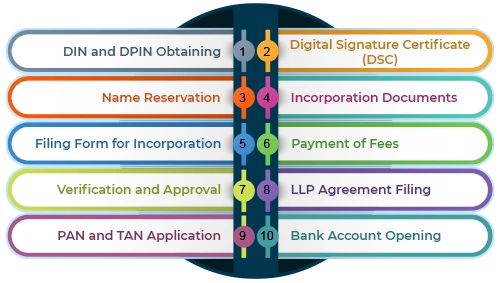
It is important to note that the LLP registration process is mainly carried out online through the MCA (Ministry of Corporate Affairs) portal. However, certain documents, such as the LLP Agreement and partner consent forms, may need to be executed and submitted as required. Once all formalities are completed and approved, the LLP is officially registered and legally authorized to commence its business operations.
Both online and offline LLP registration methods come with their own set of advantages and disadvantages, catering to different preferences and circumstances.
Online LLP Registration:
Advantages:
Disadvantages:
Offline LLP Registration:
Advantages:
Disadvantages:
Limited Liability Partnerships (LLPs) are defined by key legal features that make them a flexible and appealing business structure. A primary characteristic is the limited liability protection provided to partners, safeguarding their personal assets from the debts and obligations of the business and ensuring financial security. LLPs also offer significant operational flexibility, enabling partners to collectively manage the business and make decisions with fewer formalities than corporations. The LLP Agreement plays a vital legal role by clearly outlining the internal structure, roles, rights, and responsibilities of partners, promoting transparency and minimizing the risk of disputes.
The LLP Agreement is a crucial document in the registration of a Limited Liability Partnership (LLP), as it clearly defines the rights, duties, and obligations of the partners. It serves as the foundation for the LLP’s internal structure, outlining important details such as each partner’s capital contribution, profit-sharing ratio, decision-making process, and dispute resolution procedures. This agreement allows partners to customize the management and operational framework according to their specific needs and preferences. By clearly defining roles and establishing guidelines for handling potential conflicts, the LLP Agreement ensures transparency, smooth functioning, and long-term stability of the business.
Limited Liability Partnership (LLP) registration provides partners with significant advantages, particularly limited liability and strong asset protection. Limited liability ensures that partners are not personally responsible for the debts and obligations of the business, restricting their financial risk to the amount they have invested in the LLP. This protection allows them to conduct business with greater confidence and reduced personal risk. Additionally, LLP registration safeguards personal assets such as property and savings from business-related losses or legal claims. Even in the event of financial difficulties faced by the LLP, the personal wealth of partners remains protected, creating a secure and reliable framework for entrepreneurship and long-term business growth.
Limited Liability Partnerships (LLPs) distinguish themselves from other business structures through their flexibility in management and operations. Unlike more rigid corporate models, LLPs allow partners to manage the business with fewer formalities and greater autonomy. They also benefit from comparatively simpler compliance requirements, reducing regulatory and administrative burdens. This streamlined compliance framework saves time and resources while creating a more efficient and agile business environment.
In terms of decision-making, LLPs offer partners a high degree of autonomy that is often absent in traditional corporate structures. Partners actively and collectively participate in managing the business, making decisions collaboratively without relying on a rigid hierarchical system. This flat organizational structure encourages a more dynamic, transparent, and responsive approach to operations. It enables partners to quickly adapt to market changes, implement strategic decisions efficiently, and work together toward the sustained growth and success of the LLP.
Registering a Limited Liability Partnership (LLP) can present certain challenges that businesses must manage carefully. One common issue is obtaining approval for a unique LLP name, as applications may be rejected due to similarities with existing entities; this can be addressed by conducting a thorough name search and keeping alternative options ready. Another challenge involves accurately compiling and submitting required documents, such as identity and address proofs, where professional guidance can help ensure completeness and compliance. Additionally, drafting the LLP Agreement and meeting legal and regulatory standards can be complex for those unfamiliar with corporate laws, making expert assistance valuable in navigating the process smoothly and efficiently.
Engaging professional assistance for Limited Liability Partnership (LLP) registration can be instrumental in ensuring a seamless and efficient process. LLP registration experts bring a wealth of expertise in navigating the intricacies of legal compliance, streamlining the entire procedure for business owners. Their in-depth knowledge of corporate law enables them to guide clients through the nuanced requirements laid out by the Ministry of Corporate Affairs, minimizing the risk of oversights and errors. These experts offer tailored advice, considering the specific nature and objectives of the business, aiding in the strategic structuring of the LLP Agreement. Additionally, their proficiency extends to the meticulous preparation of documentation, such as the incorporation forms and the LLP Agreement, ensuring accuracy and completeness.
At Vishvais Counsel, we understand that Limited Liability Partnership Registration (LLP) can be a daunting process for business owners. That’s why we offer LLP Registration Service in India and provide expert guidance and support to ensure that our clients can set up their businesses with ease and confidence. Our team of experienced professionals has a proven track record of successful LLP registrations, and we help clients meet all the LLP registration requirements. Additionally, once the registration is complete, we provide the official LLP Registration Certificate to legally recognize your business. Our personalized approach to each client’s needs ensures that we deliver efficient and reliable services. With transparent communication, affordable pricing, and timely completion of registrations, we are the best choice for LLP registration services. Our hassle-free online registration process allows clients to register their LLPs from anywhere at any time, further cementing our reputation as a trusted and dependable service provider.
LLP registration is the process of registering a Limited Liability Partnership (LLP) as a legal entity with the Ministry of Corporate Affairs (MCA) in India.
GA Limited Liability Partnership (LLP) is a type of partnership in which the partners have limited liability for the debts and obligations of the business.
You can apply for LLP registration with our company by filling out our online registration form and providing the necessary documents and information.






POWERED BY

Vishvais Counsel is one of India’s leading business assistance firms, delivering customized solutions tailored to each client’s unique requirements.
